
Select a Size
4.900
Choose from predefined sizes or select custom size for manual entry
Enter quantity between 1 and 999
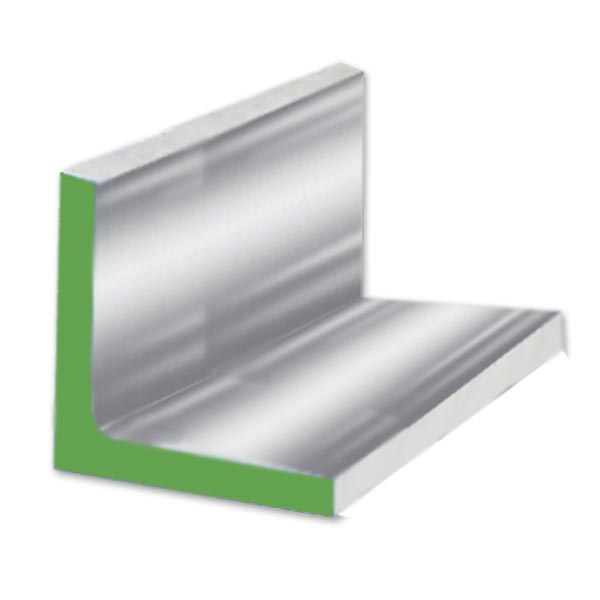
Type 304 stainless steel angles offer excellent corrosion resistance, high strength, and superior weldability. Conforming to ASTM A276, they are ideal for structural supports and architectural trim. In-stock and available for custom cutting.
Type 304 is the most widely used austenitic stainless steel, also known as "18-8" for its typical composition of 18% chromium and 8% nickel. This composition provides exceptional resistance to a wide range of atmospheric and chemical exposures. Its non-magnetic nature, high ductility, and excellent forming characteristics make it a versatile choice for fabrication. 304 stainless maintains its properties in cryogenic temperatures and offers good performance in moderate heat applications.
As an angle, Type 304 provides structural rigidity in two directions, making it a fundamental component for building frames, brackets, and supports. The 90-degree profile is ideal for corner reinforcement and creating strong, straight edges in fabricated assemblies. The material's inherent corrosion resistance and clean finish also make it a popular choice for architectural trim, food processing equipment framework, and applications where both strength and aesthetic appearance are required.
| Property | Value | Unit |
|---|---|---|
| Tensile Strength | 73,200 | PSI |
| Yield Strength | 31,200 | PSI |
| Elongation | 70 | % |
| Hardness | 123 | HB |
| Element | Percentage |
|---|---|
| Chromium (Cr) | 18.0 - 20.0% |
| Nickel (Ni) | 8.0 - 10.5% |
| Carbon (C) | 0.08% max |
| Manganese (Mn) | 2.0% max |
| Silicon (Si) | 0.75% max |
| Iron (Fe) | Balance |
Type 304 has fair machinability but is prone to work hardening. For best results, use sharp tooling, slow speeds, heavy feeds, and a quality cutting lubricant. Chip breakers are recommended as the material produces tough, stringy chips.
This alloy exhibits excellent weldability using all common fusion and resistance methods. AWS E/ER308L filler metal is recommended to maintain corrosion resistance in the heat-affected zone by preventing carbide precipitation.
304 stainless steel can be finished to achieve various appearances, from a standard mill finish to a brushed #4 or a reflective #8 mirror polish. Post-fabrication passivation is often recommended to restore the full corrosion-resistant properties of the surface.
Bobco Metals stocks a variety of related products. For applications requiring enhanced corrosion resistance, especially in marine environments, consider 316 Stainless Steel Angles. For general structural use where corrosion is not a primary concern, A36 Steel Angles offer a cost-effective alternative. We also supply 304 Stainless in other forms, including Flat Bar and Round Bar.
A: In its fully annealed condition, Type 304 stainless steel is austenitic and non-magnetic. However, it can become slightly magnetic after significant cold working, such as forming or bending.
A: 316 stainless steel contains molybdenum, which provides superior resistance to chlorides and pitting corrosion. This makes 316 a better choice for marine, coastal, and chemical processing applications. 304 is sufficient for most other general-purpose applications.
A: Yes, 304 performs very well in most outdoor environments. Its chromium content allows it to form a passive, corrosion-resistant layer. For direct exposure to saltwater or de-icing salts, upgrading to 316 is recommended for better long-term performance.
Available leg sizes from 1/2" to 1", with thicknesses including 1/8", 3/16", and 1/4". Standard lengths: 20 ft. Custom size available.
Same-day cutting and Los Angeles pickup available.
View Sizes & PricingNeed Type 304 Angles? Contact Bobco Metals for availability and Los Angeles pickup.
Request a Quote Ask an Expert1 Item
| Item Size & Description | Weight (lbs.)/Ft | Click! Arrow to Select Size | Qty | Price | Actions |
|---|---|---|---|---|---|
| 4.900 |
Choose from predefined sizes or select custom size for manual entry |
Enter quantity between 1 and 999 | Select a Size |